Friday, September 28, 2012

Chosun e-newsletter Archive Volumn 3 #10 October, 2012


NEW BOOK BY RICHARD CHUN
& DOUG COOK
Taekwondo Black Belt Poomsae -
Original Koryo and Koryo


Release Date: July 1, 2013YMAA Publications, Inc

Owing to the extensive reputation of Grandmaster Richard Chun as a modern day taekwondo pioneer and Master Doug Cook's prolific and award winning writing on the subject, this new book promises to be a landmark treatise for taekwondo practitioners worldwide.


Read entire newsletter

Thursday, September 27, 2012

Traditions Column by Master Doug Cook November Issue of TaeKwonDo Times Magazine


Not Everything Needs a Ball 

 Not long ago, my wife was speaking with the editor of our local newspaper regarding a recently submitted press release describing a public-service event hosted by the Chosun Taekwondo Academy Leadership Team, a group of young individuals who routinely engage in elevated training, provide community service on a regular basis, and utilize the virtues of tae kwon do as a vehicle to promote leadership skills.

During the course of the conversation, the editor praised the group for their tireless efforts in assisting the underprivileged and further recognized the fact that this was not the first time he had received such a bulletin publicizing our outreach program. Additionally, he was quick to note that local community leaders and citizens in concert take heed of the good deeds propagated by our students, all done with a minimum of fanfare.

Then the conversation took an interesting turn. While not coming out directly and saying so, he juxtaposed our group against various sports teams in the area whose primary mission is to dominate on the playing fields often at the cost of the very virtues supported by traditional tae kwon do training. While these entities often strive to stimulate charitable contributions as well, they do so obliquely without recognizing the noble engine that drives the process of compassion, and thus philanthropy, albeit in a benign manner. He then went on to summarize this notion by uttering the phrase “not everything needs a ball”. Given the huge popularity of varsity sports and the attention they are given by the local press, I was astonished by his comment.

At this point, I should mention that I personally have never been a sports enthusiast and, in truth, find many of the emotions elicited by such pastimes distasteful at best. By way of example, whether it be taekwondo as a sport, football or little league baseball, the unbridled actions of overzealous parents in distorted support of their offspring during the competitive process, frequently borders on riotous conduct. This atmosphere of behavior is not what we are attempting to cultivate in the traditional martial arts and to hear a man of erudition encapsulate this concept so succinctly was heartwarming indeed.

I am certain many readers will take exception with my point of view; especially those with children who participate in a variety of extra-curricular activities including those mentioned above. But it is the heritage of the Korean martial arts that stimulates the concept of giving back to ones community just as the ancient Hwarang warriors did when not occupied by battle. In my opinion, tae kwon do training undeniably represents nobility in motion. Every class is tempered with courtesy, humility, compassion and purpose. And for youngsters whose minds and hearts are uniquely open to suggestion, this is paramount.

Quite naturally, those unfamiliar with the discipline will argue, and understandably so, that tae kwon do resonates with aggression and violence, offering no socially-redeeming qualities whatsoever. And on the surface, this may be true. But if one were to take a closer look under the hood, milestones in the elevation of character will be revealed…all this minus the competitive mindset and barely masked hostility, often fostered under the guise of team sports.

As instructors of tae kwon do, we frequently say that “the only person you are competing against is yourself.” And for the most part, this is accurate effectively removing it from the fundamental doctrines of sport. Practitioners, of any age, sincerely seeking an enhanced lifestyle gradually alter longstanding habits of a questionable nature in favor of those that bolster integrity, compassion and discipline; traits that go hand in hand with cultivating an empathic worldview. Upon closer investigation, we see the long shadow cast by Confucianism on this process. Since traditional tae kwon do is influenced by the three Asian philosophical paradigms including Taoism, Buddhism and Confucianism, this is understandable.

Confucius, or more correctly K’ung Fu-tzu, espoused the cultivation of the “superior man”, one who is aware of his or her unique place in, and responsibility to, society at large. Furthermore, he taught that a single individual can influence world events through the simple projection of a benevolent state of mind. The Korean proverb, su shin je ga chi guk pyong chun fa, supports this philosophy. Loosely translated, this dictum states that, “peace within the individual brings peace within the family; peace in the family brings peace in the community; peace in the community, peace in the country and, ultimately, peace throughout the world.” As improbable as this may sound, there is little doubt that compassion towards fellow human beings goes a long way. Rather than being isolated in a vacuum, correct action ripples across humanity with much the same effect as would a pebble when dropped into a serene pool of water. Following this path leads the individual to develop a sense of purpose and harmony within the community.

Moreover, it should be remembered that the martial arts of the 21st century are significantly different from those practiced centuries ago. While self-defense remains the core purpose of practice, enrichment of character has evolved as a central theme as well. This metamorphosis began during the late 19th century with the creation of disciplines such as judo and karate-do by Gigoro Kano and Gichen Funakoshi respectfully. Martial arts intended to sustain a warrior on the field of battle became martial ways, or do, with the added benefit of building physical fitness, nationalism and morality in youngsters and college students alike. For the most part, with the exception of combat sport and MMA, this concept continues on today as the standard model in contemporary martial arts education. From this, it is not difficult to perceive the connection between a desire to improve the lives of others through community outreach and the virtuous tenets of traditional tae kwon do including courtesy, integrity, perseverance, self-control and indomitable spirit.

Lastly, while sport and all its trappings can provide an outlet for aggression and create social bonds by way of teambuilding, they all, by definition, are restricted to a set place and time. Meanwhile, the robust philosophical foundation that acted as a code of honor for the Hwarang continues to support traditional tae kwon do in the new millennium and remains as valid today as it was in the seventh century when these noble warriors sought moral wisdom beyond the zone of combat.

 Ultimately, the modern martial artist, of whatever age, should not only be physically fit and adroit in the ways of self-defense, but in addition, become a beacon of strength and courage for family, friends and those less fortunate than he or she. By extension, enriching ones community through programs of systematic outreach, particularly by young practitioners, proves beyond a doubt that “not everything needs a ball” to provide a sense of self-worth coupled with community spirit. The above, amplified by an element of self-respect, is what it means to be a true modern day warrior clad in the armor of virtuous action, tailored by a earnest study of traditional tae kwon do.


Saturday, September 1, 2012

Chosun e-newsletter Archive Volumn #3 September, 2012

Dojang News and Events

Chosun Belt Promotion Test
Sunday August 19, 2012

The Chosun
Summer Belt Promotion Test was the largest to date and was a testament to the perseverance it takes to be proficient in the art of taekwondo. From white to black belt, students demonstrated high levels of skill, technique and focus. Congratulations to all Chosun students. Special THANKS to Chosun instructors, Master Gary Stevens and Master Joseph Preira for officiating.

558599_10151111195488880_348488301_nClick image for more photos
See a video
 

Thursday, August 30, 2012

TaeKwonDo Times Traditions Column by Master Doug Cook September, 2012

The Academics of Taekwondo

Tae Kwon Do is composed of many components, most dominated by physical qualities. Front kicks, round kicks, side kicks, hand and aerial techniques abound, endowing the national Korean martial art with its unique character. Yet, as the discipline matured from its humble beginnings in the 1940s and 50s, it gained both complexity and academic dimensions until today, modern educational institutes of higher learning located in Korea offer Taekwondology, along with its comprehensive syllabus of technique, tradition, rules and regulations, as a major.

Regardless of the fact that the roots of tae kwon do date back to antiquity, historians agree that the primordial forms of the art, then known as kong soo do, tang soo do and for a brief period of time, tae soo do, were heavily influenced by Okinawan karate-do coupled with Chinese chuan fa, Japanese judo and, to some degree, aikido and jujutsu. While in transition, ritual and practice fortifying the burgeoning discipline innocently drew breath from these styles.

Then, just as the citizenry of the Korean nation were given the opportunity to reestablish their cultural and technical infrastructure - admittedly after immeasurable strife and bloodshed - so too did tae kwon do. Rising like a phoenix from the ashes of war, the disparate styles that were to evolve into a single, standardized national treasure, took on its own identity within the pantheon of Asian combat disciplines. Distinctive skills and strategies featuring philosophical underpinnings exclusive to Korean culture clearly began to emerge during the latter part of the twentieth century. This process was not easy and came at great cost, both socially and politically, to many of its founders and the organizations they would come to create. Yet, today, tae kwon do stands tall as a battle-proven form of self-defense and a fully recognized Olympic sport boasting a growth curve second to none; all this is the span of a short sixty years.
Miracles of this magnitude cannot be accomplished purely on a physical level. Rather, planning, forethought and the accumulation of knowledge must be converted into action; action stoked by the uncorrupted transmission of wisdom across generations. Lessons learned in battle during the Silla (57 BC-AD 935), Koryo (918-1392) and Chosun (1392-1910) dynasties, exemplified by warriors of the Hwarang and preserved by fighting Buddhist monks called on to defend the nation against Japanese invaders, are as valid today as they were then. Couple these tactics with a contemporary understanding of physiology, sports medicine and body mechanics, and a valid blueprint of academic standards begins to materialize.
The academic approach to tae kwon do becomes abundantly clear as one sifts through the many editorial contributions offered by scholars, masters and enlightened practitioners dedicated to the worldwide proliferation of the art. Through the magic of the Internet, technique, decorum and training rituals have been exhaustively documented for current and future use. Books, treatises and dissertations have been written to intellectually support routines and principles. These, amplified by visual aids, amount to a supreme body of knowledge that can quite literally take a lifetime to absorb. Great men and women come to mind who have generously contributed to this paradigm of data - more than not, at little or no personal gain above that of serving the art. Highly qualified individuals such as Richard Chun, Sang Kyu Shim, Jane Hallander, Kyong Myong Lee, Son Duk Sung, Sihak Henry Cho, Stuart Anslow, TaeKwonDo Times columnist Karen Eden and Alex Gillis share this distinction with others too numerous to mention.
And just what is being documented that justifies tae kwon do as a discipline worthy of academic pursuit? First and foremost, the technical catalog that defines the traditional Korean martial art. General Choi Hong Hi, a primary founder who created the International Taekwon-Do Federation in March of 1966, claimed an arsenal containing 3200 separate techniques, each with its own distinct purpose and method of execution, many depicted in his fifteen-volume Encyclopedia of Taekwon-Do. Similarly, an updated version of the Kukkiwon Textbook reissued in 2005 devotes over 700 pages to the proper articulation of technique. But wisdom accumulated over the decades does not stop there. Landmark works by Grandmaster Richard Chun and his contemporaries portray defacto training standards and procedures relied upon worldwide by hundreds of thousands of students.
Moreover, since tae kwon do is recognized as a comprehensive form of self-defense with a pedigree reaching far back to the distant past, there are metaphysical and well as physical concepts to ponder. Exploring the use of meditation and ki, or internal energy development, as essential elements of the art demands research that can only be accomplished through the interrogation of Asian historical and, in some cases, medical records compiled centuries ago. Valid examples of these are the Yellow Emperor’s Inner Canon, a cornerstone of Traditional Chinese Medicine, coupled with the physical lessons posited by the Myue Dobo Tongji (Illustrated Manual of Korean Martial Arts), authored in 1790.
Then, not to marginalize their significance, if one is to accrue an absolute understanding of any classical martial art, then it is equally essential to survey influential native customs, physiological concepts that power its engine and moral doctrines that govern its use. Many of these can be found in the teachings of Confucianism, Taoism and Buddhism.     
Clearly, taken as a whole the ingredients cited above compound to represent a body of academic knowledge profoundly worthy of transmission from one generation to the next. One only need embrace it.    
Naturally, as with any established sport, there exists a majority of practitioners who will exclusively participate for competitive purposes only. And because tae kwon do offers much in the way of physical fitness and athletic recognition on the collegiate, state, national and international level, and because just as a coin, it exhibits two sides, one representing the game and the other the art, this is entirely understandable. Yet it is important to recognize the difference between cultivating athletes and holistically-trained martial artists - practitioners who are not only proficient in the ring, but who wholeheartedly welcome knowledge concerning the vast mosaic that is traditional tae kwon do.


Thursday, August 16, 2012

Master Cook interviewed by Univision for article on Taekwondo in the Olympics

Taekwondo star siblings Steven and Diana Lopez are poised to take home the gold
By CYNTHIA MARTINEZ

Four years ago, the Lopez family was America’s best-known Taekwondo contenders in the 2008 Beijing Olympics. Not since 1904 had three siblings competed in the Olympic Games for a team, even less for one sport. The Texas brothers and sister were thus knighted as “The First Family of Taekwondo.” Steven and Diana both took home bronze, while Mark snatched up a silver medal. Big brother Jean served as the anchor and coach.

Monday, August 6, 2012

Chosun e-newsletter Archive volumn #3 August 2012

Dojang News and Events
2012 Chosun Taekwondo Academy Korea Training and Cultural Tour
Saturday July 7 - Saturday July 14, 2012

The 2012 tour was another unbridled success. Tedanhi
enhancedKamsahamnida to all tour participants, family members, friends and fellow students at home who followed us online! It is not too early to consider making a dream come true in two years by reserving your place on the 2014 Chosun Korea Training & Cultural Tour.
If you missed the Korea Travelogue, click on the site below for photos, maps, stories and more from the 2012 Chosun Korea Training & Cultural Tour. Subscribe to receive more updates and photos as they are added.
2012 Chosun Korea Tour Travelogue
Read entire newsletter

Chosun e-newsletter Archive Volumn #3 July 2012

Photo Shoot for new YMAA book by GM Richard Chun and Master Doug CookPhoto Shoot 2012 084Monday June 18, 2012
Fort Lee, NJ
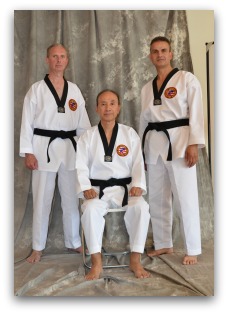
Grandmaster Richard Chun, Master Doug Cook and Master Fred Kouefati met for an extensive one-day photo shoot that would yield vibrant illustrations for the soon-to-be-published book Taekwondo Black Belt Poomsae: Original Koryo & Koryo, offered by YMAA Publications of Boston. With a release date of autumn 2013, the prime subject of the work as the title denotes, revolves around two Korean-based poomsae, or formal exercises as they are generically known.

(excerpt from upcoming article, A Photo Shoot for the Ages by Master Doug Cook)
Click image for more photos
Read entire newsletter