Showing posts with label Black Belt Essay. Show all posts

Tuesday, November 3, 2015

Chosun e-newsletter Archive volume 6 #11 November, 2015

On the Horizon
Wednesday November 25, 2015
5:30am - 6:30am
The autumn season is gloriously upon us and Thanksgiving is knocking at the door. Join black belt instructors Jake Garrett and Hal Pyke for our 17th annual Harvest Sunrise

Meditation/QiGong Class. This mindful, special session, for teens and adults only, is aimed at focusing students, friends and community members on the goodness of life rather than merely the hectic preparation for the holidays. Begin your holiday with a calm and focused mind. ALL WELCOME / NO CHARGE / NO EXPERIENCE NECESSARY. REGISTRATION REQUIRED. Email us to reserve a spot at: chosuntkd@yahoo.com, or call 845.986.2288.
Join the event on facebook! See you there!


Read entire newsletter...
Subscribe at www.chosuntkd.com

Thursday, October 22, 2015

A Retrospective of my Taekwondo Training


Bodan Essay by Brian Parkinson  October, 2015               

    It’s January 30, 2013 around 5 o’clock in the morning and I’m about to embark on an amazing journey.  One year of waiting has come to an end.  Today is the day I start training in Taekwondo.  I get dressed in my dobok for the first time, wrap my white belt around my waist and head out the door.  When I arrive at the dojang, I am confronted with a scene I am unaccustomed to.   When I bring my children for the youth classes, the dojang is a flurry of activity.  The training floor is usually crowded with students and the sitting area with
108 stone steps at Golgulsa Temple
parents.   I have never seen the dojang as it is before me now.  The lights are off with only a few corner lights to provide some illumination.  There are no crowds of children off or on the floor and the sitting area is naturally empty.  Not that I expected the dojang to be crowded at 5:30 in the morning, but the tranquil scene before me contains a power and serenity I don’t think I could have been prepared for.   I am very nervous at this point as the class consists of only a few black belts, one bodan and, I, a white belt.  It doesn’t take long for me to embarrass myself.  Master Cook has us each in turn punch a target to count.  Of course I kept punching after Master Cook stopped counting.  I felt foolish, incompetent, and of course embarrassed.   No one makes a big deal about it though, just a reminder to pay attention and not anticipate.  I remind myself to not be so hard on myself and this was a valuable lesson as I have embarrassed myself several other times over the course of the last two and a half years.
  Master Cook often says that crossing the threshold of the dojang is the hardest part of training in taekwondo.  That doesn’t mean that the rest of it is easy.  Training in taekwondo is hard.  Trying to fit it into a busy work schedule at the time I started was even harder.  The weekly sunrise class was the only class I could attend when I began my training.  I barely had time to practice outside of the dojang and after a couple of weeks I thought about giving it up.  It just seemed to be too much to learn.  I wanted to do it but I thought maybe I just couldn’t fit it into my schedule after all.  I rebuked this notion and pressed on.  After a couple of months I was invited to test for yellow belt.  So much consternation and trepidation surrounded this first belt test that I feel the cathartic sense of elation when my fist smashed through the board would be hard to beat. 
                I advanced to yellow belt with a new-found confidence and determination to train.  I remember enjoying this belt cycle.  New techniques like back stance and side kick were of course challenging to learn but I never felt overwhelmed as I did at white belt.  I attended class regularly and after three months successfully tested for orange belt.  Orange belt is considered one of the more difficult color belts.  Many people realize at this belt level that taekwondo is not for them and quit.  I had resolved to never quit unless I had to for health or financial reasons at white belt, so that was never a concern for me.  I loved orange belt.  Its many challenges felt right somehow.  Progress in taekwondo often comes slow, sometimes almost imperceptive but at orange belt the progress felt tangible and this only spurred on my desire to train.  I was even graced with an award for outstanding achievement at the belt test.  Every time I look at that award atop my entertainment center in my living room, I can’t help but smile.
               The green and blue belt cycles were probably the hardest for me.  My wife had surgery during my green belt cycle and I found myself taking on just about all of the household work she normally does.  This left me physically drained but I tried to never show how tired I was on the floor.  Once I step on the floor of the dojang, I feel all other concerns must be set aside.  If I made mistakes, I vowed to practice more instead of making excuses due to fatigue.  It wasn’t easy though and I struggled through the entire green belt cycle.  At blue belt I had to take my own hiatus from training to have a cyst removed from my back.  My dermatologist forbade me to train for three weeks, unless I wanted to rip out my stitches and risk further infection.  Three weeks felt like three years.  I couldn’t help but feel disconnected from taekwondo which of course let all the demons of self-doubt run rampant.  I marked the date of my return in my appointment book and anxiously awaited its arrival.  When I was able to return, I had just enough time before the belt test to feel ready.  Blue belt came to end with my foot smashing through a board with an ax kick.
               Without a doubt purple belt will always be the most special for me.  It was during this belt cycle that my entire family traveled to S. Korea on the Chosun Korea tour.  I am not well traveled.  This was only the second time I had traveled outside of the United States.  I think I am still processing all of the ways in which that tour has affected me and my training.  From all day training with Master Ryan An to touring the brand new Taekwondon, I think I could write a separate essay just about Korea.  Of course there are some standout moments.  Performing poomsae at Tong-Il Jeon Shrine was a very powerful experience.  I can’t help but feel that a part of the Hwarang’s martial spirit came home with me.  Our last training session was with Grandmaster Gyoo Hyun Lee.  Although I didn’t get to train personally with Grandmaster Lee as he took the black belts, I was given a Master instructor, Master Lee, by Grandmaster Lee.  I was informed that Master Lee is a champion in Taeguk Oh Jang.  My disappointment over not getting to train with Grandmaster Lee evaporated immediately.  He personally assigned a master instructor who had won competitions in my form-what more could I ask for?  Although my wife and I tried as hard as we could, we struggled with the changes to the form and the language barrier.   Master Lee’s frustration was evident.  Master Lee was so frustrated with us at one point that he simply walked away from us.   I was reminded of Gichen Funakoshi performing the same form all night to the point of humiliation for Anko Itosu.  I refused to give up.  I kept performing the form.  Master Lee noticed that I continued even though he walked away and came back over and continued to teach.  When we posed for a group picture later on, he came and sat next to me for the photo, an honor to be sure.
               Shortly after returning from Korea, I successfully tested for my red belt.  Red belt is known as danger within the Gup system for the practitioner is in possession of advanced techniques at this point, but not necessarily the discipline required to use them wisely.  For me, red belt felt like turning a corner.  There are many new techniques at red belt like the first use of a strength motion in a poomsae that clearly set it apart from the earlier belts.  I remember Master Wynne teaching me Palgwe Oh Jang and stopping me after only the first few motions.  “Stop.  Go Back.  You need to show a better back stance”.   I did.   “Stop.  Your knife hand is pitched wrong.”  Good thing I had been through this with Master Lee in Korea.  I was undeterred.  I know Master Wynne was only trying to help me improve so I kept at it.  I don’t think I’ll ever start that form without thinking of her.
 The next two belts:  brown and high brown seem to have melded into one long period in my mind.  When testing for brown belt, I encountered a new problem.  The required break is a hop-step hook kick.  Even though kicking is not my strong-point, I felt confident about this break.  I stepped forward and unleashed the kick only to feel my foot bounce off the all too solid board.  As a lower belt, this would have undoubtedly rattled me a great deal.  Instead of allowing my initial failure to deter me, I reset and performed the kick again breaking the board easily.  Afterward, watching the video my son took of the break, my wife and I noticed that we had both done the exact same thing.  We both failed on the first try, reset and then broke the board.  At brown belt my Korea training again benefited me.  The first stepping basic for brown belt is cat stance.  Every Korean master began our training with a review of all stances so I didn’t feel as confused by this new stance as I probably would have been had I not trained in Korea.  On test day I went home with a high brown belt wrapped around my waist.  The first appearance of black in a belt let me know that this was it.  I was entering the home stretch of the color belt cycle.  The next belt test had me advancing to bodan with a spinning hook kick as the required break.  I don’t think I had been so nervous about a break since white belt but somehow I did it on the first try. 

               The last six months as a bodan have been very different.  For one thing, there is very little new to learn.  Palgwe Pal Jang is the only requirement that is truly brand new.  Since I have been practicing and reviewing the entire color belt curriculum all along, I never felt pressured to remember all the past techniques.  Instead, I have been trying to focus on all of the details and improve upon them.  Just because I learned back stance all the way back at yellow belt, doesn’t mean there isn’t room for improvement.   As a result, I initially found bodan to be a fun belt.  While everyone else was confused at the beginning of the belt cycle by the new techniques they were learning, or stressing the upcoming belt test at the end of the cycle, I just had to keep training.  However over the last few weeks, I can feel a subtle and undeniable change occurring.  Much the way someone who has stayed up all night can sense the approaching dawn, I can sense a change occurring in my training.   I have always taken training in taekwondo seriously but now as I approach black belt I feel there is a responsibility to the art that wasn’t there before.  Master Cook often says that black belt is a license to learn and not a permit to quit.  I can’t agree more with this sentiment.  Being a black belt doesn’t mean resting on your laurels.  I feel that when that black belt is wrapped around my waist it doesn’t mean that I mastered the color belt curriculum.  It doesn’t mean that I have nothing else to learn.   It does mean that I persevered through the color belt curriculum and have now proved myself worthy of further instruction.  I am looking forward with great enthusiasm to exercising my license to learn.

A Retrospective of my Taekwondo Training so far

 Bodan Essay by Bryce Parkinson  October, 2015                                                            
   I’ve heard it said that life is not made of up of weeks, or months or even years, but of moments. In looking back on my time as a color belt at Chosun, I know this in my heart to be true, for it is most definitely made up of many special and memorable moments.
   Recently, during a Tuesday evening all belts class, not long after the belt test while on line for ill Suk Si I took a minute and looked around the dojang. As a bodan , I already knew what my belt level requirements were while the rest of my classmates were just learning
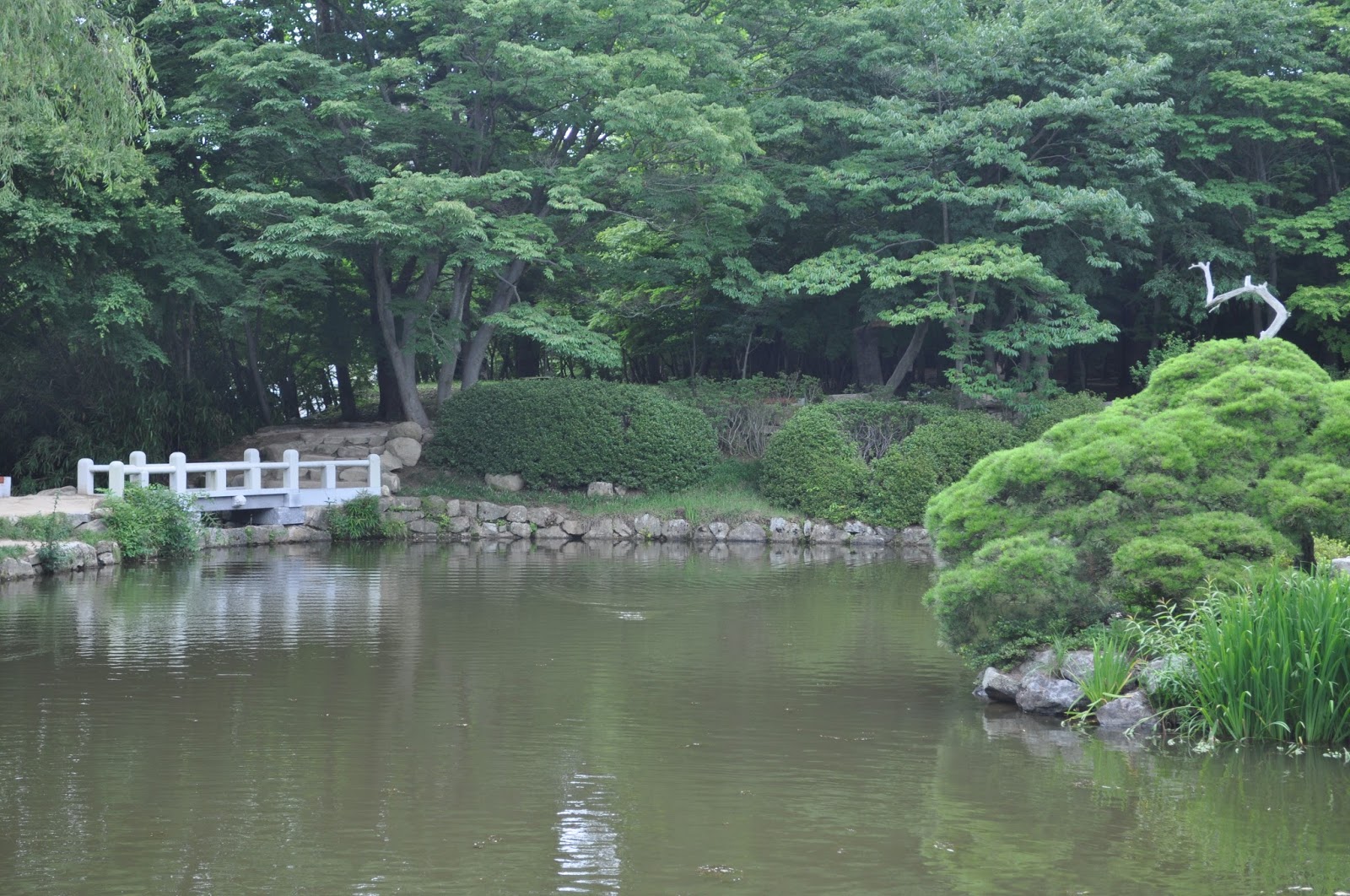
Pond at the entrance to Bulguksa Temple
theirs. The room was busy with activity. Students of all ages and ranks were with instructors learning new forms and one step sparring. The energy in the room was electric with the collective desire to learn Taekwondo and the eagerness of students with new techniques to work on. In that moment, the dojang was alive with the spirit of Taekwondo, strong  and vibrant , and I was a part of it. I know that that energy will stay with me forever, inspiring me to always meet new challenges with enthusiasm  .
   Throughout   my training in the past two and a half years, there have been so many of those memorable moments. And with each one Taekwondo has revealed to me new things about myself that sometimes I didn’t even know I had within me. At my first test for yellow belt, I was so sick I should not have been on the floor. I couldn’t even do my stepping basics right. It took me a long time after the test to trust that even with my mistakes, I had earned that yellow belt, and I needed to take credit for my achievement. Recognizing my achievements is a lesson I’m always learning and has remained one of the hardest issues for me throughout my training.
At my test for orange belt I was awarded the honor of student of the month and had to read my essay in front of the whole school. That day I learned that I am not afraid to speak in front of large groups. As an orange belt, it took me weeks to learn how to do a double knife hand block. I was increasingly confused and frustrated with every class. It seemed I would never learn it, no matter how hard I tried. Then one day, after weeks of practice, it  clicked. I was finally able to do it. The sense of accomplishment I felt was incredible and I learned that I indeed had perseverance.
   I was a green belt for six months, due to health issues. It taught me that patience is a vital part of my training. It was almost torture watching my family leave to train while I had to stay home and recover. Stepping back on the dojang floor was an incredibly rewarding experience. I felt like I had come home to where I needed to be. I remember actually crying when Master Ehrenreich handed me my blue belt. I absolutely loved being a blue belt. My training truly seemed to be taking shape, the sense of constant confusion I had was dissipating and I could see progress within my techniques. It was during that time that my family and I decided to join the Chosun training tour to South Korea.
   My husband Brian and I tested for our purple belts in May 2014.   In July 2014 along with our two sons who were  bodans at the time, and around thirty other students of all ranks and ages, we boarded a plane at JFK to South Korea. Now those “other students” are affectionately known as “Korea Family”. I had never been out of the country before. Never in my wildest dreams did I ever expect to go to South Korea. From the moment we committed to going,  it became one of the most memorable experiences of my life. I was challenged and rewarded in ways I could never have predicted. Recently I was telling a friend about one such challenge. I was walking  at the bottom of the mountain trail at Seokguram Grotto and all of a sudden I began to feel extremely ill. I was dizzy and felt incredibly sick. Later on I would come to find out I had Vertigo.  I had to send my son Dylan  to get my husband who had walked on ahead of us. At that point my friend interrupted me, asking me if I had my husband take me back to the hotel or at least back to sit on the bus. I was puzzled, and told them that no, with my husband and a friend’s help, I went up the mountain and saw the Buddha and came back down with the group. I might have been last going up and coming down, but I did it. I realized that it never occurred to me to not go up the mountain. Korea showed me without a doubt that I have indomitable spirit. And that was only one part of one afternoon there.

A month or so after returning home, I became a red belt. It was then that a member of my “Korea Family” asked me a very important question. One that has stayed with me almost every day since he asked it. How had my time in Korea changed me ? Every time I ask myself that question , I come up with a new answer. From a better cultural and historical understanding of the land that Taekwondo originates from, to a better understanding of myself, and why I train, the answer is continually unfolding to me, even a year later.


By brown belt I had been volunteering on the Leadership Team for a few months, and found that I truly loved working with the children. I knew then that I wanted to become an assistant instructor, and that I wanted to specifically work with our youth population. That is another new thing Taekwondo has taught me about myself. I love working with children. Soon my belt went from brown to high brown and that first appearance of black in a belt came in. I became even more focused on training, knowing that soon I would become a black belt candidate.

   When I finally became a bodan, everything about the belt was different than my previous belt ranks. While my classmates were learning new techniques, I was perfecting ones that I had learned over the past two and a half years. I also had more time to reflect on those special moments that made up my training   so far. Like learning to fall with the Garretts or working with Master Ehrenreich for twenty minutes to get the first step of Plagwe Oh jang right. Or meeting Grandmaster Chun for the first time.
  As my time as a color belt comes to a close, I realize how much I am going to miss this important time of my training. I have been blessed with extremely knowledgeable and compassionate instructors, and a very supportive group of peers. While I know that these things will not  change once I become a black belt, I also know everything will change. That this is a first milestone along a lifelong journey. A journey full of revelations of all kinds.  Training in traditional Taekwondo at Chosun has changed my life forever. It has taken me places, physically, spiritually mentally and even literally ( Korea !) that I never dreamed possible.

As Master Cook frequently says: “Upwards and onwards!” 

A Retrospective of my Taekwondo Training

Bodan Essay by Thomas Lennon  October, 2015


            When I first heard the essay assignment we were tasked to do, I thought to myself, BODAN ESSAY? A  Retrospective of training through the color belts?  WOW, I could not believe how fast my training through the color belts has gone! Master Cook was absolutely right when he instructed us to enjoy the color belts while we are in the moment. It goes fast, and before you know it you will all be Black Belts! I guess the old saying holds true, time does fly when you are having fun. 

     When I first started training as a White belt, the road looked long and complicated ahead. I could barely stand in a good front stance. I remember being so proud of my new Dobok that my wife and I stopped at a beautiful scene in Waywayanda State Park to take pictures. I look at those pictures now and we both kind of chuckle and pick out all the deficiencies in the block and stance. Those pictures were taken only a few short years ago. Now we are performing Poomsae with cat stances that we throw front kicks from. It is simply amazing to me the progress we have achieved at Chosun!  
     Master Cook tells a story about how proud he was when he first got his yellow belt.  He would walk down the street with his head held high and his chest out. I have the same feeling he described every time I advance, even a little bit, in Taekwondo. That’s what Taekwondo training does for me. It keeps me humble, trying to learn new techniques and it rewards me with a sense of pride and accomplishment when I perform well, never mastering always learning to perfect my performance. Taekwondo never lets me down. The Poomsae are always teaching me something I can do better. 
     As far as a retrospective of my training here at Chosun, it goes without saying, I would not have advanced even from the first step of Alle Makki Ap Koobi without the hard work and dedication from Master Cook and the sincere training that his instructors give to every one of the students that cross the Dojang door. I can make a case that if it weren’t for the patience of instructors like Mr. Garrett and the “coaching techniques” of Master Klugman I may not have made it passed Orange belt. I owe a great deal to all the instructors at Chosun, and of course Master Cook for giving my wife and I a new life in Taekwondo! 
     Only a few short weeks ago I was questioning myself, “was I ready to become a Black belt … was I worthy?”  I was a color belt and proud of it.  “Is it too soon to advance?” I thought about this for some time and realized the curriculum at Chosun was designed by much higher powers than myself, and if I am being told I’m ready by the experts, who am I to doubt their judgment.  So here I am at the end of one more important lesson from Taekwondo, ready to take another humble step!  Kamsahamnida Chosun!

A Retrospective of my Taekwondo Training

 Bodan Essay by Patricia Lennon                       October 2015

It’s all about the journey

As soon as I became a Bodan, I felt that I should somehow be “different”.  I was a little nervous at first – wondering “what” exactly should be different about me.  Soon, I began to notice some changes.  A small “error” in class felt “humongous” to me!  How could I do that?  I am a Bodan!  Then, something kicked in.  Maybe it was the beginnings of an indomitable spirit.  I responded to my error, with tenacity and determination – I would not let a misstep throw me off.  Instead, I trained harder.  I was almost glad I had made a
Gyeongju Plains-Home of the Hwarang Warriors
mistake, because it gave me the opportunity to strengthen my “will”, and focus my mind.  In martial arts, we are taught that our focus needs to be in the moment, mindful and aware.  You have to move on to the next moment, the next move, maintaining the positive energy that we call Ki.  Ki is the energy that flows through us – giving us an indomitable spirit.

As I move closer toward Black Belt, it seems that three specific martial arts concepts seem to be unfolding for me.  They are the basic martial arts teachings of “mindfulness”, “Ki development” and the “indomitable spirit” that we are called to internalize during our recitation of the five tenets of taekwondo.

Reflecting on these concepts, it becomes clearer to me that this is a life long journey – a process, which does not happen overnight, and which demands that I have patience - with myself, and with the training process.

A journey requires patience, and, I believe, patience requires courage.  Therefore,  I en-courage myself!  I remind myself that I will be a black belt soon!  I accept the many responsibilities that come along with this process – two of which are to train harder than I think I can, and to show good spirit!  I know that the “good spirit” that we are encouraged to show is more than a loud kihup, or throwing hard punches, blocks and kicks.  I believe it has more to do with “taking full custody of one’s life”, which is the journey we are on.

The journey is a personal one.

I suspect the changes in the transition to Black Belt will be subtle, gentle stirrings - 
felt subjectively, before becoming externally apparent.  We train for ourselves, first and foremost.  Not for outward appearance or appreciation.  The journey is a personal one.  Although we train together – and we do form bonds – we have a common purpose, and that is reason enough for such bonds to form.  We encourage each other, sincerely and enthusiastically, passionately and compassionately – always reveling in one another’s progress. 

We are truly “team mates” and “school mates”, yet always on our individual journeys.  Like a family, its members bound by many things - yet always and forever - walking their own paths, learning their own lessons, in their own ways – struggling, facing road blocks, overcoming them, mentally, physically and spiritually – challenged, and strengthened by the challenge.

Each small hurdle overcome adds another small muscle to one’s memory – until it becomes unforgettable – forever a part of us.

We are people on a very similar journey - kindred souls, lovers of an art – one in which the artist moves into - and flows with - at their own pace – an art that moves the body.  I am sure dancers and yoga practitioners must reap similar rewards.  Martial Arts, Yoga, Dance – they are all artistry in motion!

Taekwondo is an art form that puts you in touch with your strength – your inner ki strength – and your outward physical strength.


My authentic spirit yell

I think that finding your own kihup, your personal, authentic spirit yell, is part of this path we are on.

When we visited Chosun Rockland to participate in their women’s self defense class, we encouraged the women to “kihup” when they hit the target.  I noticed that some of the women were noticeably quite uncomfortable with yelling out the word kihup.  I understand that this, in part, could be because they’ve never done it before.  They may never have spoken the word “kihup”, no less yelled it, loudly, in front of a group of strangers. 

I remember the first time I let out a loud kihup.  Up until that day, I had probably whispered my kihups.  As white belts, we were taught that we needed to kihup in order to get more power into our moves, and in addition to this, it “showed good spirit”.  And our training had much to do with “spirit”.  After all, an indomitable spirit is one of the 5 tenets of Taekwondo.   So I would try to kihup, but I really didn’t know how.   I loved the translation of the word – “spirit yell”.  I really wanted my spirit to yell.  And I noticed that some people had louder spirit yells than others.  I had a feeling that it didn’t matter so much how loud my kihup would be.  But I still had some apprehension about it.  On this particular day, I did actually kihup quite loudly.  I remember that I was quite surprised about what had just come out of my mouth.  Just then, one of the black belts that I had been training with regularly, Master Sammy Testa, gave me a “thumbs up”, and ‘a look’ that said something like “you go girl!”.   She had witnessed my very first real kihup!  I won’t forget that day.

One Buddhist teaching says – you are already what you are seeking to become.  With this in mind, I think that the ki energy and indomitable spirit is already in me.  And that Taekwondo is a path which can lead me to this energy, this life force.

It reminds me of the art of photography.  The photographer sees something, and wants to savor it.  It’s already there… in its natural state.  The photographer snaps the photo… and goes back to the dark room … and develops the film – at first it appears that there isn’t anything on the film – but slowly – the image starts to appear – and, as if from nothing, there is it.  It was always there – the photographer just had to develop it.  And so it is with my ki.  And my indomitable spirit.  I am slowly but surely developing these aspects of myself – through my training.  Uncovering what is already there.  I look at Taekwondo as a true art form.  I realize it is a form of self defense – but for me, on a daily basis, as an integral part of my life, it is also an art form.  And in this way, it is much like music, or sculpture.  Artists have said that the music, or the statue – was already there – in its entirety – the image of it was in their mind’s eye, and they just needed to uncover it. 

And so it is with my spirit yell – not so much the actual yell that comes out of my mouth, but more, the place where the indomitable spirit within can find it’s voice, and express itself, authentically. The voice within that yells out – I have trained really hard!  I am a Martial Artist!  I am a White Belt! ... a Yellow Belt!......I am a Bodan!  I am a Black Belt.  Finding that voice is the source of my training -- developing my martial arts voice - my ki -  my indomitable spirit

The Warrior’s Path

Since I am practicing the Eastern tradition of Taekwondo, it follows naturally to investigate some of the philosophy at its foundation.  Zen is a basic philosophy behind the martial arts.  The Samurai warriors practiced Zen as a way of life. 
“Mushin” is the essence of Zen.  It is Mindfulness.  Mushin is a peaceful state of mind – one of pure mental clarity.  This is the way of the martial arts warrior.  It is, indeed, a peaceful way, and we are “defenders of the peace”. 

We encounter other warriors on the trail - humble warriors, who walk softly on this path – ever mindful of past travelers, and future ones.  In some, their “Ki” is almost visible.  And when you speak with others, their “spirits” practically yell out.  It is not the “kihup” sort of  “yell” that I am referring to, but a more subtle kind - an indomitable spirit, which has truly developed with much hard work, perseverance, and passion for their practiced art.

Our pilgrimage begins at the Dojang.  As with any traveler who dares to take a road less traveled, it will not be smoothed, nor tamped down by previous travelers, because there are relatively few. 

We are all homeward bound warriors – and when we meet our fellow “HoBo Warriors”, we humbly bow to one another – out of respect, and comradery, and reverence for the noble cause that we are all defending, and recognition of a similar spirit. 

We are martial artists, we continue to train, journeying from the dojang, to a place within ourselves, growing in strength, developing our martial spirits, and then, journeying back again, to the dojang, the place where we, together, strengthen our spirits. There, we gain strength and courage, and fine tune the balance - between strength and gentleness, courage and humility.

~~~~~~~~~~~~~~~~~~~~~~~~