"How we do anything is how we do everything"
Sensation is the voice of the body and the practice of yoga can teach us how to understand that language. Whether we like it or not, when an unpleasant sensation comes up on the mat, we face ourselves. How do we react? Do we meet the challenge head on or do we retreat? This week in the reflective pose of Kurmasana (Tortoise) we will be in perfect place for an encounter with ourselves.
Join us for personal discoveries...
Chosun Taekwondo Academy & Hatha Yoga Center
62 Main Street Warwick, NY
Class Schedule:
Tuesdays 9:30am
Wednesdays 6:30pm
Saturdays 9:30am
First Class is Free
$15 per class / $130 for 10 classes
Tuesday, April 8, 2014


Weekly Thoughts from Chosun Yoga March 26, 2014
"Transitions"
The calendar says...Spring is here! But the temperature says "Wait a minute...not so fast! Like any transition period, patience, balance and trust are required to bridge the gap and make for a smooth landing on the other side. On the yoga mat this week, we will practice vinyasas (consecutive poses using breath) as a way to navigate the sometimes uncertain steps from point A
to point B.
Join us for smooth landings...
Chosun Taekwondo Academy & Hatha Yoga Center
62 Main Street Warwick, NYClass Schedule:
Tuesdays 9:30am
Wednesdays 6:30pm
Saturdays 9:30am
First Class is Free
$15 per class / $130 for 10 classes
The calendar says...Spring is here! But the temperature says "Wait a minute...not so fast! Like any transition period, patience, balance and trust are required to bridge the gap and make for a smooth landing on the other side. On the yoga mat this week, we will practice vinyasas (consecutive poses using breath) as a way to navigate the sometimes uncertain steps from point A
to point B.
Join us for smooth landings...
Chosun Taekwondo Academy & Hatha Yoga Center
62 Main Street Warwick, NYClass Schedule:
Tuesdays 9:30am
Wednesdays 6:30pm
Saturdays 9:30am
First Class is Free
$15 per class / $130 for 10 classes
Friday, March 21, 2014
Weekly Thoughts from Chosun Yoga - March 19, 2014
"Stop, Breathe, Re-organize and Surrender"
Many of us are drawn to the practice of yoga seeking a change. Sometimes we can get stuck in our habitual way of doing things and the change we want eludes us. Yoga teaches us to step back, look at our mind set, discern what is truly "good for us" (not just what feels good), let go and breathe through the process. Then we experience change that is true to who we are. This week, we will sit in Vajrasana and become witnesses of our own unfolding.
Join us and surrender...
62 Main Street Warwick, NY
Class Schedule:
Tuesdays 9:30am
Wednesdays 6:30pm
Saturdays 9:30am
First Class is Free
$15 per class / $130 for 10 classes
Tuesday, March 4, 2014
Chosun e-newsletter Archive Volumn 5 #3 March, 2014
Dojang News and Events
Belt Promotion Test
February 9, 2014
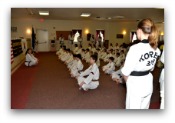
Be sure to view the photos and video from the first belt promotion examination of 2014. From white to black belt, Chosun students displayed tremendous skill and technique. Congratulations to all students on your achievements.
Click image for more photos
View a video montage of the test
Read entire newsletter...
Click image for more photos
View a video montage of the test
Read entire newsletter...
Thursday, February 27, 2014
Holistically Embracing Traditional Taekwondo by Master Doug Cook
Article appeared in Totally Taekwondo Magazine June, 2013 issue#52
Over the years, after
teaching over 18,000 taekwondo classes, I have found that some practitioners approach
the principles of the martial arts as they would a menu from a restaurant,
making one selection from column “A”, and another from column “B”. This outlook
is particularly common among newcomers and those who have not been exposed to,
or genuinely embrace, the philosophical underpinnings of traditional taekwondo.
In everyday life this habit is called “cherry-picking” and while it may work in
food, fashion and farming, it does not work in the sincere study of taekwondo.
Korean martial arts doctrine can be viewed as a complex mosaic composed of many
ideas foreign to the Western mind. Selectively removing or ignoring any of
these concepts for whatever reason, significantly reduces the value of
traditional taekwondo training.

As I have written about
previously, the martial arts are intrinsically tied to the three Asian
philosophical paradigms of Buddhism, Taoism and Confucianism. Each of these in
their own rite has contributed greatly to the fertile ground that nurtures the
seeds of discovery and enlightenment exclusive to takwondo. Consequently, the
training process, physically, spiritually and mentally, will bear fruit only if
the practitioner permits nature, and the wisdom inherent in these ancient
ideals, to run their course. Just as an apple will not ripen properly if picked
too early or, at worse, die on the tree if exposed to pollutants in the soil,
so the taekwondoist will suffer if the principles that separate the martial
arts from a common life style are conveniently discounted or overlooked
altogether.
Let us take, for example,
something as deceptively simple as the bow of courtesy so ubiquitous in
taekwondo. I say “deceptively simple” due to the fact that, on the surface, an
uninitiated onlooker merely sees two individuals inclining their upper bodies
at a precise angle towards one another. Undoubtedly, the bow, which replaces
the handshake in many parts of the world, holds obvious salutary value. However,
we as martial artists realize that there is much more to this action than meets
the eye. Aside from a demonstration of respect, the bow, or kyungye in Korean, represents a myriad
of implied principles; principles that must be upheld if taekwondo is ever to
survive in a classical form. Bowing to a fellow student represents an
acknowledgement that the techniques we practice can be lethal if abused and
therefore must be wielded with self-control and governed by nobility. Likewise,
bowing to a master instructor is not only an expression of respect and humility,
but an essential sign of loyalty unhindered by outside influences and
personalities regardless of their apparent short term benefit. Moreover, in
reciprocity, the master instructor is silently annunciating to his student that
he will watch over them and do his best in helping to navigate the often
confusing journey through taekwondo however demanding he may seem. Likewise, an
instructor bowing to a fellow instructor not only implies mutual respect, but that
they will treat one another with honor in their relationship. Lastly, bowing at
the threshold of the dojang before entering is yet another manifestation of the
student’s appreciation for the holistic practice of traditional taekwondo. This
simple gesture recognizes the spiritual boundary that separates the routine of
everyday life from the supercharged atmosphere of the dojang; the sacred place where
we come to study the Way. Given the
depth of this gesture, how could anyone fail to formally acknowledge the
virtues portrayed therein?
Vocal cues, too, hold
special significance to those who practice taekwondo in its fullness. In an
effort to minimize the loss of students due to an overt demand for discipline, some
schools have eliminated the required reply of “Yes, Sir” or “Yes, Ma’am” that
is spoken by a junior when addressing a senior student or instructor. Moreover,
the spirit yell, or kihop, that is so
vitally required to amplify a strike, block or kick, is often overlooked and
rendered unnecessary.
Similarly, the exclusion
of meditation, ki (internal energy) development exercises, basic technique
practice, self-defense drills, and most urgently, forms or poomsae, from the standard curriculum due to a strong emphasis on
sport competition, has a devastating effect on the student’s overall maturity
as a complete martial artist. All of these omissions eat at the very foundation
of traditional taekwondo leaving less and less to transmit to future
generations as an inheritance.
For the most part, the
ideology of taekwondo when practiced as a classical martial art, is forged in
the fires of Asian culture. Naturally, we in the West often find this world
view difficult to conceptualize. For instance, once, while training in Korea, I
recall seeing an instructor strike a student with a kicking target simply
because he felt the student was not performing up to par. In that setting the
teacher’s punitive action was not construed as being unusual or cruel. Try the
same action here, however, and the instructor could be facing a potential law
suit. Moreover, training for eight hours at a time, as we did, in a dojang with
interior temperatures of ninety degrees or more, is commonplace in Korea and
elicits not a word of criticism. I provide these experiences for the reader’s
consideration not because I support them, but because they unmistakably drive
home the point that there are fundamental differences in the way we approach
our training locally as opposed to the manner in which it is practiced in Korea, taekwondo’s
country of origin. To complain about an instructor there is unthinkable. To
question his authority is worse. Yet, behavior of this nature is not unique to
taekwondo in and of itself, but represents a microcosm of Korean society at
large. It is neither right nor wrong; it simply is and tends to stem from the
hierarchal societal structure embedded in Confucian thought.
Metaphorically speaking,
if one wishes to truly absorb the culture of a nation, they must attempt to speak
the language, eat the food, dress accordingly and conform to the local customs.
While a dilution of tradition by a small component of the martial arts
community must be taken into account, the same guidelines hold true for
traditional taekwondo; one must accept its physical component, mental
requirements and cultural principles as a whole without condition.
Clearly, the complete
and sincere practice of taekwondo is not for everyone. In order to achieve
excellence in our training, we must subjugate ego, bend to seniority, practice
diligently and without complaint, remain loyal to style and school, and
finally, act with honor in establishing trust between teacher and student.
Remaining steadfast to these seemingly superhuman ideals does not require a
character of messianic proportions; rather, it demands a noble heart and an
unswerving love for the martial arts that only those willing to accept traditional
taekwondo in its cultural entirety will be able to develop.
Master Doug Cook, a 6th
dan black belt, is head instructor of the Chosun Taekwondo Academy located in
Warwick, New York, a senior student of Grandmaster Richard Chun, and author of
three best-selling books entitled: Taekwondo…Ancient
Wisdom for the Modern Warrior, Traditional
Taekwondo - Core Techniques, History and Philosophy, and Taekwondo–A Path to Excellence, all
published by YMAA of Boston. Master Cook and Grandmaster Chun have recently
completed a new book, Taekwondo Black
Belt Poomsae: Original Koryo and Koryo, targeted for publication in July of
2013. Master Cook can be reached for lectures, workshops or questions at www.chosuntkd.com or info@chosuntkd.com.
Tuesday, February 25, 2014
Discipleship by Master Doug Cook
This article appeared in Totally Taekwondo Magazine January, 2014 issue #59
Disciple. To most,
the word conjures up vivid images of religious devotion or a pious commitment
to a spiritual icon or canon. And well it should since the concept defines a
symbolic marriage between novice and mentor, a spark of intention to an ideal.
But, most importantly, as it applies to taekwondo, this connection can be
construed as an unimpeachable union between loyal student and venerable master.
When we think
of the term disciple, many Westerners visualize the Twelve Apostles of Christ,
also known as disciples. Yet, viewed from the standpoint of the practicing martial
artist, this comparison is not too distant from its sacred use.

Taekwondo, or
foot-fist-way, is first and foremost a traditional martial art and world sport.
It is not in any way, shape or form a religion even though it has been
influenced by the three Asian philosophical paradigms of Buddhism, Confucianism
and Taoism. Nevertheless, several of the almost superhuman individuals responsible
for founding the discipline – men, in this case, who sacrificed almost
everything to promote the Korean martial arts in their formative years -
clearly deserve dutiful fidelity just as in the context of a religion. Equally
deserving, are the remaining, living legends who continue to carry the torch of
tradition forward.
Why is this? Why
would anyone in this day and age sublimate themselves and, in some cases, even
forfeit, their own energies in the service of another? And, having done this,
what are the benefits, if any.
In its current
iteration, traditional taekwondo can be thought of as a direct reflection of
modern society’s quest for a ritualized entity, devoid of religious dogma, but
complete with a physically and spiritually enhanced set of ethical principles
by which to live. It satisfies an innate desire for a clear path to achievement
while softening the competitive impediments imposed by the workplace,
scholastic institutions or the gaming fields. Moreover, as one travels through
the belt ranks, the profits revealed by focused training almost certainly alters
the student’s life in a profoundly positive, yet frequently surprising, manner:
practice mimics a mirror - on the one hand highlighting strengths, while on the
other, reflecting weaknesses that beg correction. Intense introspection of this
nature never fails to arouse passions and emotions that have been buried by
age, self-imposed isolation or cynicism compounded by an egocentric worldview.
The notion that martial arts training, particularly when experienced by adults,
can have a significantly restorative effect on the individual is not uncommon.
So it stands
to reason that almost any system catering to the cultivation of the physical
and spiritual self, will spin off personalities that embody the ideological
foundation of the whole; those who symbolize the human incarnation of doctrine
and exemplary physical practice. Consequently, the purveyor leading one on this
transformative path can, for better or ill, assume almost messianic
proportions. To the sincere martial artist whose desire for excellence is pure,
this presence is manifested in the form of a master or grandmaster and it is to
this person that a pronounced, yet appropriate, homage is paid.
While, as a rule,
monthly tuition is paid in return for instruction, this often meager fee can
never truly compensate a master adequately who earnestly and selflessly wishes
to pass on a genuine martial inheritance. Subsequently, it is not unusual for
the master to remain vigilant for a student who stands out, prepared to receive
direct transmission of skill. Those that exhibit the elevated standards that
satisfy the expectations of the senior, at some point, may come to be
considered a disciple. It is clear that these individuals are few and far
between. While the undeserving grasp desperately for a position of singular
recognition and advanced transfer of often hidden knowledge, sometimes stepping
on the backs of others to do so, it can only be those possessed of pure
intention, extraordinary patience, unblemished humility and unshakeable
devotion, who will reach the summit.
The disciple
is differentiated from the average student in that they seek the deep
philosophy, customs, etiquette and history associated with the art, in
conjunction with physical technique. The implied code of honor governing
unprovoked use of lethal skill is intricately woven into their moral fabric. With
nothing whatsoever casual about their practice, the disciple develops a
laser-like focus, undiminished by the rigors and challenges of training. In
short, rather than coming to taekwondo, they become taekwondo.
Furthermore, discipleship
often exceeds the boundaries of loyalty, bordering instead on obsequiousness.
To outsiders, a close aid to the standard bearer can appear to obviate his or
her own identity in the support of their senior. Friction and criticism may
arise meted out by those less worthy of the station. This situation, supported
by historical precedence, is to be expected and, ultimately, endured.
So, given the almost
divine characteristics that flirts with the impossible associated with discipleship,
what are the benefits of this noble, yet subservient, condition?
Notably, the
disciple is assured of instruction uncorrupted by misinterpretation. That is to
say that the individual is not learning technique from a string of instructors
originally taught by the master. Instead, they are benefiting, as mentioned
earlier, from direct transmission of skill, sometimes taking on even the most trivial
of the master’s idiosyncrasies. Metaphorically speaking, just as a document
losses integrity over the course of successive copies, so frequently will
technique. This first-hand communication of knowledge - physical, spiritual and
intellectual - is perhaps the most important advantage of discipleship. Through
total immersion in the art, the disciple becomes a sturdy link in the great
chain of martial arts knowledge. They share in a legacy by association and
through martial action. The disciple virtually becomes a vessel containing the
original essence of the master’s teachings and, through osmosis, will be expected
to carry this legacy forward in perpetuity.
Nonetheless,
there is an additional variable in this equation: is the master eminently
deserving of and justified in receiving disciples? Is the leader, not being
possessed of sainthood and still capable of misjudgments, worthy of
unquestionable loyalty and respect by an apprentice?
While this is
murky territory to trample in, and since the Western mind is a questioning
mind, there are several signifiers that can be utilized in identifying a master
truly worthy of an egoless devotion on behalf of the journeyman. First, examine
past actions. Look closely at the deeds and not merely the words of the one in
which years of devotion will be invested. Average these out, however,
underscoring significant triumphs while down playing benign human traits or
frailties. Personally speaking, I recall my astonishment when I discovered,
while training in Korea, that our masters smoked excessively and drank alcohol
in the evening with abandon. I was young and immature then and did not fully
appreciate the Eum and Yang of life as I do now, being advanced in years. These
men - great masters - reflecting a generation of hardship and war, were simply
living their lives as was customary within the parameters of their society.
Yet, from morning till night, each day, they had every intention of teaching
traditional taekwondo with total conviction and accuracy. And, they did. In
these investigations, do not confuse mundane behavior with pathology.
Additionally,
interrogate intentions. Martial arts institutes and masters are not regulated
as are other professions with the exception of guidelines suggested by various,
legitimate organizations including the Kukkiwon, WTF, ITF, ATA, USTA, WTA, TAGB
and the GBTF. Therefore, in an effort to ferret out unbridled greed, If invited,
the serious student of taekwondo must ask: Do dollars trump tradition in this
potentially honorable relationship? Is the aim of the master’s instruction to
teach taekwondo, or is to manipulate and perpetrate odious sales tactics in the
practice of take-my-dough? And finally, is the senior demanding minions and
serfs, or are they earnestly searching for a few elite students on whom they
may imprint a lasting stamp of authenticity?
Today, when we
consider the concept of discipleship, we reflect on fusions of individuals such
as General Choi Hong Hi and Tae Hi Nam, Dr. Un Yong Kim and Rhin Moon Chun,
Gichen Funakoshi and Osamu Ozawa, Jigoro Kano and the Four Kings, and perhaps
most prominently, Ip Man and Bruce Lee, just to name a few. Considering the
long standing relationships between these men, discipleship may at first appear
to be a long, lonely and arduous road. Yet, in truth, it is a two-way street; for
example, Jigoro Kano, during the early years of the Kodokan, provided room,
board and care for his disciples, all with funds from his own pocket. So,
regardless of the effort sustained, trust in the master and his or her ultimate
desire for the student’s well being is crucial. It must be realized beforehand
that not every training session or personal interaction will result in
contentment. Discipleship will demand a pledge to a long and lasting
relationship that will range across the peaks and valleys of progress and
disappointment. No patch will ever be embroidered with the term disciple. In
fact, the phrase may never even cross the lips of the teacher and student
involved. Nevertheless, when this special bond develops, cemented by a mutual
desire for technical and philosophical preservation, it will become obvious. To
serve when called insures continuity; tradition is in need of worthy vehicles in
order to advance and there are praiseworthy mentors waiting to shift them into
drive.
Master Doug
Cook,
6th dan black belt, is head instructor of the Chosun Taekwondo
Academy located in Warwick, New York, a senior student of Grandmaster Richard
Chun, and author of four best-selling books entitled: Taekwondo…Ancient Wisdom for the Modern Warrior, Traditional Taekwondo - Core Techniques,
History and Philosophy, Taekwondo–A
Path to Excellence, and Taekwondo
Black Belt Poomsae: Original Koryo and Koryo, co-authored with Grandmaster
Chun along with its companion DVD. Master Cook can be reached for seminars,
workshops or questions at www.chosuntkd.com or
info@chosuntkd.com.
Tuesday, February 4, 2014
Chosun e-newsletter Archive Volumn 4 #2 February, 2014
Chosun Taekwondo Academy presents:
A Day for Women Celebrating Character, Courage and Commitment
Sunday March 16, 2014
9:30am - 3:30pm
Chosun Taekwondo Academy

62 Main Street Warwick, NY
Join guest Master Yoga Instructor Paula Heitzner RYT, Chosun Instructor Jake Garrett, Master Doug Cook and the Chosun instructors for a day that celebrates your character, courage and commitment.
Read entire newsletter...
A Day for Women Celebrating Character, Courage and Commitment
Sunday March 16, 2014
9:30am - 3:30pm
Chosun Taekwondo Academy
62 Main Street Warwick, NY
Join guest Master Yoga Instructor Paula Heitzner RYT, Chosun Instructor Jake Garrett, Master Doug Cook and the Chosun instructors for a day that celebrates your character, courage and commitment.
Read entire newsletter...
Subscribe to:
Posts (Atom)